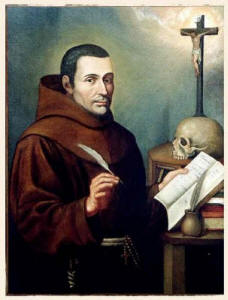
John Charles Marchioni was born at Sezze, Italy, on October 19, of humble parents. A shepherd as a child; he wanted to become a priest. When unable to do so because of his poor scholarship (He barely learned to read and write), he became a lay Franciscan brother at Naziano. Served in assorted menial positions at friaries near Rome and became known for his holiness, simplicity, and charity. Once a friary superior ordered Charles, as porter, to give food only to traveling friars. While Charles strictly adhered to the new rule, simultaneously the alms to the friars decreased. He
|
convinced the superior the two facts were related. When the friars resumed giving goods to all who asked at the door, alms to the friars increased.
He wrote several mystical works, and at the direction of his confessor, his autobiography, The Grandeurs of the Mercies of God. St. Charles wrote, “God does not command us to live in hair shirts and chains, or to chastise our flesh with scourges, but to love Him above all things and our neighbor as ourselves.” Fr. Severino Gori wrote, “The autobiography of Charles stands as a very strong refutation of the opinion, quite common among religious people, that saints are born saints, that they are privileged right from their first appearance on this earth. This is not so. Saints become saints in the usual way, due to the generous fidelity of their correspondence to divine grace. They had to fight just as we do, and more so, against their passions, the world and the devil.”
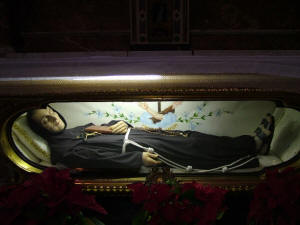
Charles lived a life of great mortifications, and worked heroically to help the stricken in the plague of 1656. He was sought out for spiritual advice, and the dying Pope Clement IX called Charles to his bedside for a blessing. He was canonized by Pope John XXIII in 1959.
 |
Lord God, you kept St. Charles of Sezze faithful to Christ’s pattern of poverty and humility. May his prayers help us to live in fidelity to our calling and bring us to the perfection you have shown us in your Son, who lives and reigns with you and the Holy Spirit, one God, for every and ever.